
The Spinal Column & the 5 Directions
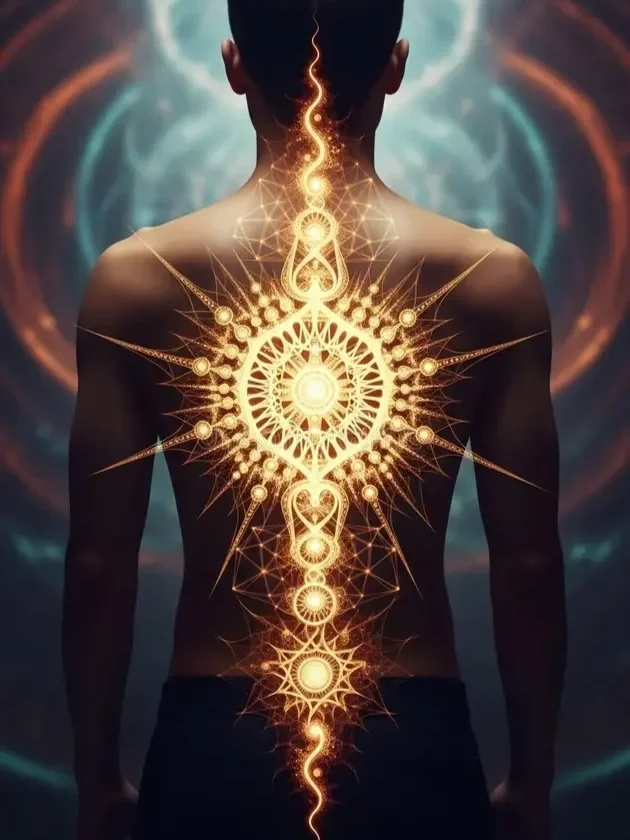
The spine is both conduit of the nervous system and pathway of prana. It is not a rigid column but a dynamic, fluid-responsive system. Enclosed within a membranous sheath of fascia called the dura, the spinal cord floats in cerebrospinal fluid that rises and falls in subtle tides. These oscillations are influenced by posture, breath, and movement, and can be sensed as an internal rhythm—a fluid exchange between sacrum and cranium. Ligaments spanning from sacrum to skull stabilize this axis, while their reciprocal tension transmits kinetic currents throughout the body’s central channel.
The central axis of our spinal cord houses millions of nerve fibers carrying sensation, movement, and autonomic rhythms. From this axis, heart rate, digestion, blood pressure, and the subtle balance of homeostasis are regulated.
The five directions of spinal movement —flexion, extension, lateral bend, rotation, and axial elongation—each change the contour of this central field. By shaping the vertebral column in these ways, yoga practitioners influence the rhythmic flow of cerebrospinal fluid—the clear, life-sustaining liquid that bathes the brain and spinal cord—along with the elasticity of the intervertebral discs and the tensional balance of the surrounding fascia.
Bowing In: Flexion | Forward Bends
Like a horse straining at the reins, the front body is often propelled into planning ahead and pulling us forward with urgent strain. Flexion is an energetic antidote to this demand; a yielding gesture that softens the front body to bow in and release the constant tug of productivity, letting gravity's hold on us guide the fold.
In flexion the front body draws closer together while stretching open the long sheath of muscles and ligaments along the posterior chain. The gentle tug of fascia unfurls along the entire backline of your body—beginning at the rooted pull of the heels, threading upward through broad calves and strands of hamstrings, weaving into the long sheath of the spinal erectors elongating like a suspended rope, each vertebra tractioning from the stability of the sacrum. The crown of head descends toward the ground like a pendulum, inviting the neck to soften and sway. This posterior chain does not end at the neck; it arcs over the dome of the skull and pours forward, spanning across the scalp into the tender skin of the forehead.
Meanwhile, attention is drawn inward and downward, steeping awareness into the basin of the belly and coaxing the nervous system toward quietude. In this way, forward bends redirect energy from the ceaseless push of doing into the quiet refuge of being.
Rising to Meet Life: Extension | Backbends
Spinal extension is an act of opening, of brightening, of rising to meet life. Where forward folds draw awareness inward and downward, backbends call it outward and upward. They awaken what has been collapsed, irrigating the heart and lungs and clearing stagnation from the chest.
Anatomically, extension arcs the spine, like a bowstring drawn into readiness, as intervertebral discs are compressed along the posterior while the long front body—abdominals, hip flexors, and chest—spreads open. The sternum lifts off the spine, the frontal ribs broaden, and the shoulder blades descend.
In his later years, founder of Iyengar Yoga and modern master B.K.S. Iyengar devoted himself almost exclusively to backbends, believing they could counteract gravity’s relentless work on the aging spine and keep vitality buoyant. In his way, the posture became a kind of defiance: a refusal to shrink or collapse. Each backbend can be a quiet uprising, a valiant gesture against gravity’s slow persuasion, a reclamation to meet life -from a bright and lifted heart- in full span and stature.
The front body unfurls like a sail catching wind, the lungs swelling as twin hulls of a ship, as the tidal tug of prana swirls and eddies within the sanctum of the heart.
The Crescent Arc | Side Bends
A dear friend and gifted bodyworker once told me the sense of freedom we feel in our lives is directly informed by the space we have in our side bodies. Energetically, side bends invite breath into the hidden alcoves between the ribs, irrigating the lungs and creating a lateral spread for prana to reach. Where forward folds coax us inward and backbends lift us skyward, side bends branch out from the trunk like limbs reaching out toward the light. They awaken the kidneys, stretch the side waist, and dissolve stagnation from the intercostal fascia. Prana is pulled into a lateral tide, widening perception into the peripheries of awareness, as though the inner horizons themselves have expanded.
Anatomically, lateral flexion arcs the spine into a graceful crescent, shortening the intercostal muscles and fascial sheaths on one side while lengthening the tissues on the other. The quadratus lumborum and obliques gather into a fold of contraction, while their counterparts elongate along the waist in tensile stretch. The ribs on the outer arc fan apart like shutters opening to light or gills drawing in current. The spinal cord shifts its suspension delicately toward the curve, influencing cerebrospinal flow and enhancing elasticity along the flanks of the torso.
Like a young sapling swaying, the spine bends but does not break. Its pliancy reveals asymmetry as dialogue, each vertebra tilting and translating in a graceful negotiation between root and reach.
Spiraling the Qi Body: Rotation | Twists
Like vines coiling up a tree, tendrils of curled smoke, or the fractal unfurling of ferns, rotation carries us into the universal geometric design of spirals, the essential pattern of life itself.
Twists wind through the vertebral bodies, spiralizing the fascial sheaths along the central axis to gather Qi, twirling it into elegant, expressive motion. Often described as a “rinsing” of the core, rotation functions not only in the subtle body but biomechanically, renewing fluid exchange within the intervertebral discs and nourishing the tissues that encase the spine. The obliques cinch across the waist, one side contracting while the opposite elongates in a diagonal pull. The rib cage winds around its axis, ushering the flow of cerebrospinal fluid into a helical stream.
Echoing the double helix of DNA and the unfurling arms of galaxies, Prana courses the spine as a braided current, sweeping residue away and kindling clarity at the body’s core. Growth and evolution do not unfold in straight lines but along winding pathways. The body, like the universe, learns through rotation—through the artful coil that gathers, releases, and redistributes life force.
Grand Rising: Axial Elongation | Lengthening Spine
Like a tree trunk rising from vast roots, like mountains ascending from the earth’s crust, or a flame narrowing into a tall, steady column- axial elongation is the spine’s most essential vector. It offers an uplifted, dignified gesture of verticality to elevate the circulation of cerebrospinal tides. Axial elongation is the expression from which all other spinal directions originate, the vertical axis around which every movement finds orientation.
Anatomically, the deep stabilizers such as transversus abdominis and pelvic floor engage in subtle co-activation, providing a tensile lift from below, while the diaphragm domes lightly above. Instead of muscular bracing, elongation is achieved through distributed effort: the fascial matrix draws upward and transmits an even lift. Each vertebra ascends from the next in a living continuum, expanding the spine’s hydraulic rhythm.
Rooting through the tailbone and ascending through the crown will decompress the intervertebral discs and suspend the spinal curves in balanced tension. In this state of buoyant equilibrium, the spine supports the body’s weight with greater ease and harmonizes the nerve signals and subtle currents- an inner architecture both grounded and uplifted.
Energetically, axial lift aligns the central channel as a clear conduit for Qi. The body becomes a reed through which breath and awareness can flow unimpeded, a central plumb line for balance and poise. A living column between earth and sky, stable at its base yet endlessly rising toward light.